The Philoxena Cistern—a forgotten underground palace supported by 224 columns in the heart of Istanbul
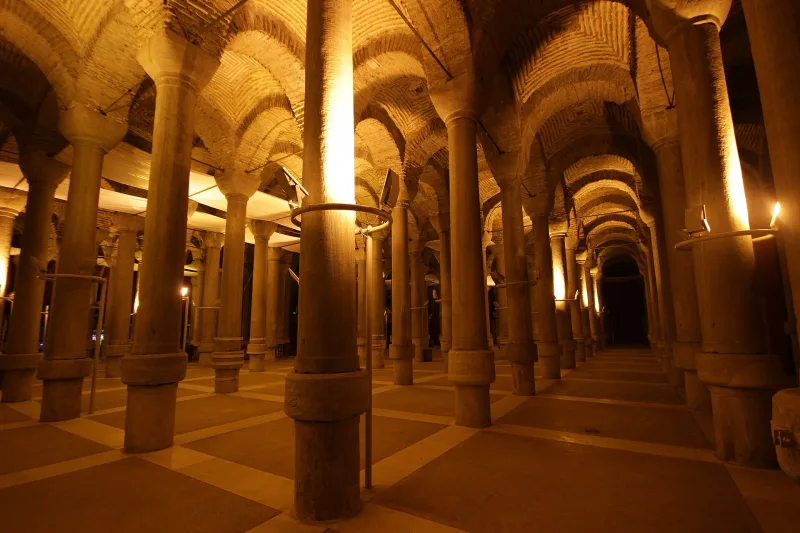
Beneath the cobblestones of Sultanahmet, just a stone’s throw from the hustle and bustle around the Blue Mosque, lies one of the most remarkable monuments of Byzantine Constantinople—the Philoxena Cistern, or Binbirdirek (Binbirdirek Sarnıcı), meaning “a thousand and one columns.” This is Istanbul’s second-largest underground cistern after the famous Basilica Cistern, and it is precisely here that you should descend to see Byzantium without the crowds. The Philoxenos Cistern is located between the ancient Forum of Constantine and the Hippodrome of Constantinople, in the Fatih district, at İmran Öktem Sokak 4. Its 224 marble columns, each 14–15 meters high, assembled from two shafts and bound by marble rings, stretch in even rows through the dim light, while the vaulted brick ceilings create the impression of a flooded basilica without walls.
History and Origin of the Philoxenus Cistern
The history of this reservoir dates back to the 4th century, to the era of the first Byzantine emperors. According to ancient sources, construction of the cistern was begun by a senator of Roman origin named Philoxenus—possibly as early as the reign of Constantine I, the founder of Constantinople. Russian tradition recounts a legend that the work may have been carried out beneath the city palace, which is often identified with the Palace of Antiochus. Turkish sources date the construction to the 4th century, during the reign of Constantine the Great, and retain the name of Philoxenus as the person responsible for the project.
The cistern’s fate took a dramatic turn in the 5th century. In 475, a devastating fire completely destroyed the Palace of Laus, located above it—one of the greatest residences of early Byzantium. Following this catastrophe, Emperor Justinian I undertook a large-scale restoration of the underground reservoir in 528 (according to Russian sources) or in the 6th century (according to English sources). It was during the Justinian era that the Philoxenus Cistern acquired the appearance we see today.
Until the mid-12th century, the reservoir was fed by the city’s main aqueduct—the Valens Aqueduct. When it could no longer cope, the cistern began to be filled from the Peris storage cistern and simply with rainwater. Everything changed in 1453. After the Ottoman conquest of Constantinople, the underground reservoir became unnecessary: the Ottomans preferred flowing springs and did not like to drink the stagnant water from cisterns. Binbirdirek gradually emptied and was literally forgotten for two centuries.
Its rebirth occurred in the 17th century, during the construction of the Fazli Pasha Palace: workers accidentally stumbled upon the vault of a gigantic underground hall. A grim legend from that time tells of a woman named Cevahirli Hanım Sultan, who allegedly lured men to her, killed them, and threw their bodies into the cistern. American writer Mark Twain mentions in his 1860 travel notes that silk workshops were located in Binbirdirek, and Turkish sources add that the cistern had served as a crafts workshop since the 16th century.
The reservoir’s subsequent fate was a sad one: holes gradually formed in its vaults, into which locals dumped trash. The holes grew larger, the hall became overgrown with junk, and by the 20th century, it seemed that the Byzantine monument was lost for good. The turning point came only in the early 2000s: during a major cleanup in 2002, more than 7,000 truckloads of trash were removed from the cistern—only then did the 224 columns see the light of day again. At the same time, a modern entrance and a short gallery connecting the hall to the street were constructed. Russian Byzantinist S. A. Ivanov, in his guidebook *In Search of Constantinople* (2011), examines this history in detail and reminds us that underground Istanbul still harbors dozens of similar cisterns, which we are only just beginning to discover.
Architecture and What to See
The Philoxenus Cistern is not just a reservoir, but a full-fledged architectural masterpiece. It covers an area of 3,640 square meters (3,584 m² according to Turkish data), with the hall measuring 64 by 56.4 meters, and its capacity reached 40,000 cubic meters of water. This is comparable to the volume of a large modern swimming complex, only entirely hidden underground.
Hypostyle Hall and Double Columns
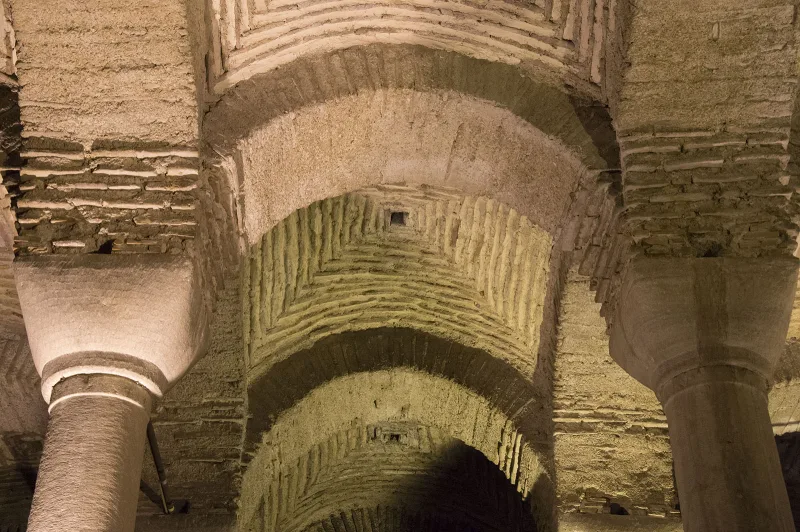
The main space of the cistern is the hypostyle hall, where brick vaults rest on 224 marble columns arranged in 16 rows of 14 each. The height of the columns ranges from 14 to 15 meters, which is extremely rare for underground structures. One feature that immediately catches the eye is that each column is assembled from two shafts placed one on top of the other and fastened together by a marble ring in the middle. This design allowed for the use of shorter columns while still achieving an impressive vault height. Turkish sources note that of the 224 original columns, 212 have survived to this day.
Prokonnesos Marble and Capitals
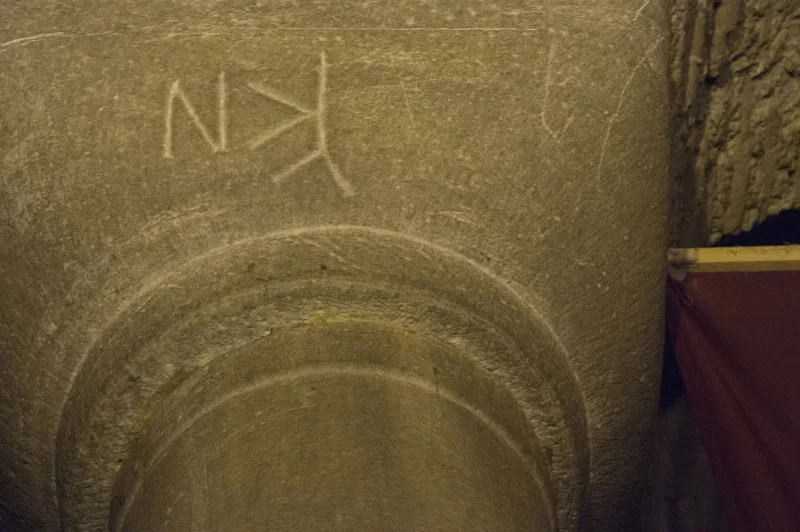
The material for the columns was quarried on the nearby island of Marmara, ancient Prokonnesos—a famous Byzantine quarry that supplied marble to nearly the entire capital. The capitals are devoid of ornamentation and shaped like truncated pyramids, emphasizing the functional rather than decorative nature of the space. Short inscriptions in Greek letters have been preserved on the shafts and capitals: according to one theory, these are the personal marks of stonemasons and foremen of the guilds; according to another, they are Masonic marks. These barely visible letters turn the tour into a unique quest: look closely at the columns, and you will see the “signatures” of people who worked here 1,500 years ago.
Lost Levels and the Excavated Basin
Originally, the reservoir had three tiers connected by staircases. The lower tier was apparently used to discharge silt and excess water—today it is inaccessible. During the modern restoration, the bottom was not completely cleared, so the lower part of each column remains hidden beneath layers of “historical debris.” To allow visitors to appreciate the original proportions, a small pool with four fully exposed columns was dug in the center of the hall. It is here, by this black rectangular pool, that you grasp the true scale of the structure. The pool essentially functions as an archaeological “cross-section”: standing next to it, you can literally gaze up at the original Roman height of the column and imagine how, a thousand years ago, maintenance workers paddled around on flat-bottomed boats, checking the water level.
A Modern Space: Cafés, Concerts, and Exhibitions
Today’s Binbirdirek is not just a museum. Following a major restoration in the early 2000s and the connection of the entrance gallery to the street, the cistern became a multifunctional venue. Under the arches, there are small souvenir stalls, cafes, and exhibition areas; art exhibitions, chamber concerts, banquets, and even weddings are held here regularly. Such “living” use of a monument is a common practice in Istanbul, but in the case of the Philoxenus Cistern, it is particularly fitting: an empty hall sounds too quiet.
Interesting Facts and Legends
- The name “Binbirdirek” translates from Turkish as “1,001 columns,” although there are actually only 224. The Turkish phrase “binbir” is used as an idiom meaning “a vast number”—much like the Russian expression “a thousand and one reasons.”
- The darkest legend dates back to the 17th century: a woman named Cevahirli Hanım Sultan allegedly lured men into her house above the cistern, killed them, and dumped their bodies into the underground hall—which is precisely why Binbirdirek was long avoided.
- In 1826, during the “Favourable Event” (the dissolution of the Janissary corps by Sultan Mahmud II), about 100 Janissaries who tried to hide in the cistern drowned in its waters—one of the most tragic chapters in the history of this place.
- Mark Twain, who visited Istanbul in 1860, noted in his travel journal that Binbirdirek housed silk-processing workshops—a typical example of ancient engineering being repurposed as a craft workshop.
- During the cistern’s cleanup in 2002, more than 7,000 truckloads of trash were removed—rubbish that had been dumped through holes in the vaults for centuries—a rare instance where an archaeological site is literally unearthed from household waste.
- Some modern researchers doubt that Binbirdirek is the same as the historical Cistern of Philoxenus—it is possible that the two sites have been confused with one another for centuries.
How to get there
The cistern is located in the heart of Sultanahmet, within walking distance of all the main sights of the old city. The exact address is İmran Öktem Sokak 4, a two-minute walk west of the Hippodrome and Sultanahmet Square. Use the Blue Mosque as a landmark: it is exactly 250 meters along the side streets from its southwest corner to the entrance of Binbirdirek.
The most convenient way to get there is by taking the T1 tram line to the Sultanahmet stop. This line runs from Kabataş through Eminönü and Sultanahmet, connecting the cistern to all the key points of historic Istanbul. It’s a 5–7-minute walk from the stop to the entrance. From Istanbul Airport (IST), take the M11 metro to Kağıthane, then transfer to the M7 and the T1 tram (total travel time is about 1.5 hours). From Sabiha Gökçen Airport (SAW), the most convenient option is to take the Havabus to Taksim and then transfer to the funicular and tram.
Binbirdirek is easy to combine with other routes on foot: 5 minutes from the Basilica Cistern, 10 minutes from the Grand Bazaar, and 7 minutes from the Hagia Sophia Museum. Parking in Sultanahmet is extremely limited, so park your car in advance or take a taxi.
Tips for travelers
Plan for a 45–90-minute visit: this is enough time to leisurely walk around the perimeter, examine the columns with Greek inscriptions, descend to the excavated pool in the center, and, if you’re lucky, catch a temporary exhibition. The best time to visit is in the morning right after opening and on weekdays: unlike the neighboring Basilica Cistern, there are never any lines here, and the hall feels almost private.
A few practical tips: it’s cool inside year-round (12–15 °C), so even in the summer heat, bring a light jacket or scarf. The lighting is dim, and smartphone cameras can be finicky—turn on night mode or bring a small tripod if you want to take blur-free photos. The floor is uneven and damp in places; comfortable shoes with non-slip soles aren’t required, but highly recommended. For Russian-speaking travelers, the audio guide will most likely be available only in Turkish and English, but a few printed facts from this article will more than make up for it. You can and should bring children here: the scale of the hall impresses a child more than any history textbook, and the legend of the “1,001 columns” is easy to remember for both five- and ten-year-olds.
A combination of three underground sites in Sultanahmet in a single day works perfectly: the Basilica Cistern — the Theodosius Cistern (Şerefiye Sarnıcı) — and Binbirdirek. The best order is this: start with the most famous one, continue with the medium-sized Şerefiye, and finish right here, at the most intimate one. I recommend checking the current opening hours and ticket prices on the official website before your visit—museum hours in Istanbul change from time to time. And one last tip: the Philoxenus Cistern is a place where the rule “less rush, more silence” really applies: stand for a couple of minutes near one of the double columns, listen to the echoes of footsteps under the arches, and you’ll understand why the Byzantines believed that the greatest monument to engineering is one that outlives the empires themselves.